STATEMENT
4–6 Seater Extendable South African Mid-Century Modern Dining Set in Solid Kiaat by Artecasa – Expertly Restored with Genuine Leather Upholstery
4–6 Seater Extendable South African Mid-Century Modern Dining Set in Solid Kiaat by Artecasa – Expertly Restored with Genuine Leather Upholstery
Couldn't load pickup availability
This expertly restored Mid-Century Modern dining set by Artecasa,
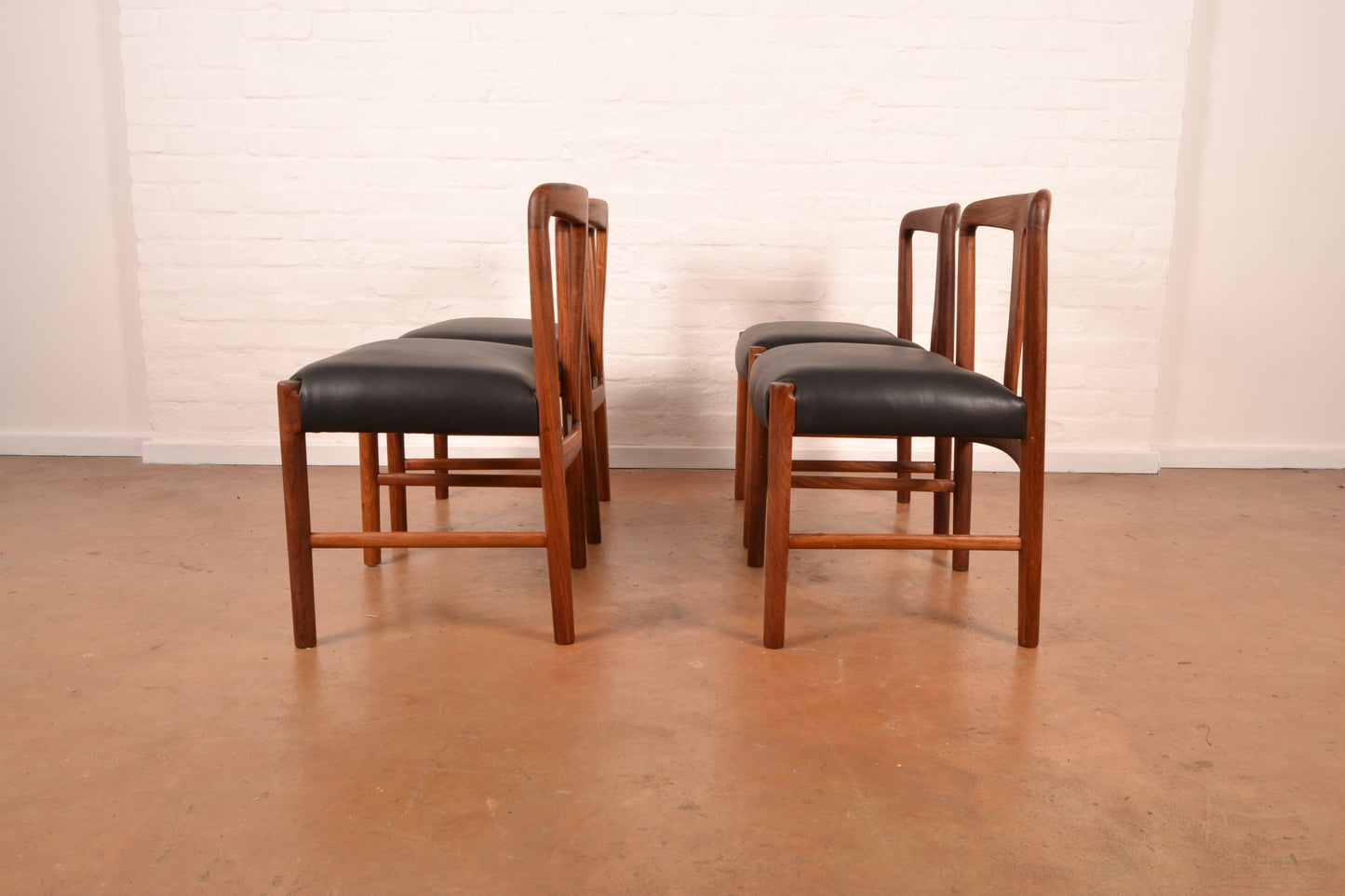
includes a solid Kiaat extendable dining table and four matching dining chairs - upholstered in full-grain genuine leather.
Designed and manufactured in Johannesburg between the 1950s and 1980s, this authentic vintage South African dining suite comfortably seats four - and extends to accommodate six to 8 people at a squeeze - making it ideal for both everyday dining and entertaining.
📏 Key Specifications
Dining Table
H: 74cm | W(diameter): 136cm - 196cm extended
Dining Chairs (Set of 4)
Width: 49cm | Depth: 49cm | Height: 81cm
🪵 Materials
- Solid Kiaat timber throughout
- Full Grain Genuine Leather upholstery.
Colour: Wild Horse Black
🗜️ Expert Construction & Restoration
Manufactured by Artecasa in Johannesburg during the Mid-Century Modern era (c.1950s–1980s), this dining suite has been thoroughly restored by Statement Collectables to preserve its original craftsmanship while ensuring decades of continued use.
The dining table features a robust extension mechanism,
allowing it to elegantly transition from a compact four-seater to a generous six-seater.
Constructed entirely from solid Kiaat, it offers exceptional durability, rich natural grain, and the warm character that has made Kiaat one of Southern Africa's most sought-after furniture timbers.
The matching dining chairs have been fully restored and reupholstered in premium full-grain genuine leather.
New high-density foam & top quality inners provide modern seating comfort while maintaining the clean architectural lines characteristic of authentic Mid-Century Modern design.
Perfect for collectors of South African Mid-Century furniture, Scandinavian-inspired interiors, contemporary homes, or anyone seeking an authentic vintage dining set crafted from solid timber rather than modern veneers or engineered board.
🏷️ Price: R25 789
Despite our thorough restoration process with all the authentic vintage pieces that we sell, most of which are 60+ years old, minor signs of age related character may remain.
-
Artecasa Furniture – Peter’s Personal Favourite
South African History & Contemporary Relevance
Artecasa (Art for the Home) was established in Johannesburg in 1951 by two Italian immigrant brothers, Dino and Gianni Maraschin, who brought with them a strong European tradition of cabinetmaking and design.
The Maraschin brothers were trained within the Italian tradition of furniture making, which emphasized proportion, joinery precision, and material honesty.
Arriving in South Africa in the post-WWII period, the Maraschin brothers were part of a broader wave of European artisans and entrepreneurs who contributed significantly to the development of local manufacturing.
(Many other Italian craftsmen who found themselves at the tip of Africa at the time - were captured prisoners of war.
My late-grandfather always spoke of the magnificently constructed mountain passes we have in the Cape that were engineered & built by the Italians.
There is a special cemetery & Memorial garden en route to Cullinan from Pretoria that commemorates this community)
At a time when South Africa’s furniture market was transitioning from purely utilitarian production toward more design-conscious, modern pieces, Artecasa positioned itself at the intersection of Italian modernism and local craftsmanship.
(Many Italian designers were heavily influenced by Structural Rationalism & Monumental forms driven by the embodiment of Pre-War Fascism. There’s an excellent documentary on this topic titled Ben Building: Mussolini, Monuments and Modernism"(2016) by Jonathan Meades for BBC)
In Johannesburg, the brothers established a factory that combined:
- European design sensibilities
- Semi-industrial production methods
- Skilled local labour
Artecasa became known for producing high-quality domestic furniture—particularly dining suites, sideboards, and cabinetry—characterised by:
- Clean, modernist lines
- Functional, extendable forms (e.g., butterfly and leaf tables)
- Careful timber selection, often using locally available hardwoods such as kiaat
- A balance between durability and refined aesthetic appeal
Their work aligned broadly with mid-century modern principles, but adapted to the South African context—both in material availability and consumer taste.
As a result, Artecasa pieces were widely distributed and became staples in middle-to upper-income homes from the 1950s through the 1980s.
They were known for hands-on involvement in production, maintaining quality control while scaling output. Their business model reflected a hybrid approach—more refined than mass-produced furniture, but more accessible than bespoke cabinetmaking.
However, like many mid-century manufacturers, the company’s prominence declined with:
- Increased imports of cheaper furniture after the lifting of sanctions
- The shift toward flat-packed and mass globalised production providing a wider consumer product offering
- And the resultant changing of consumer preferences in the late 1980s–1990s.
(It is rumored that the supply of Kiaat also started drying up after the end of the bush war - I’ve heard that the army often supplied the local furniture manufacturing market with dirt cheap timber from the Northern Namibian & Angolan Forests)
PG